All of Us Are Dead (2022) is a harrowing South Korean survival horror series that reimagines the zombie apocalypse through the lens of adolescence, fear, and moral collapse. Set primarily within the walls of Hyosan High School, the show transforms a familiar teenage environment into a claustrophobic battleground where survival becomes the only lesson left to learn. Directed by Lee Jae-kyoo, the series combines intense action and visceral horror with emotional storytelling, exploring not only how humanity breaks down under pressure but also how it persists in the face of despair.
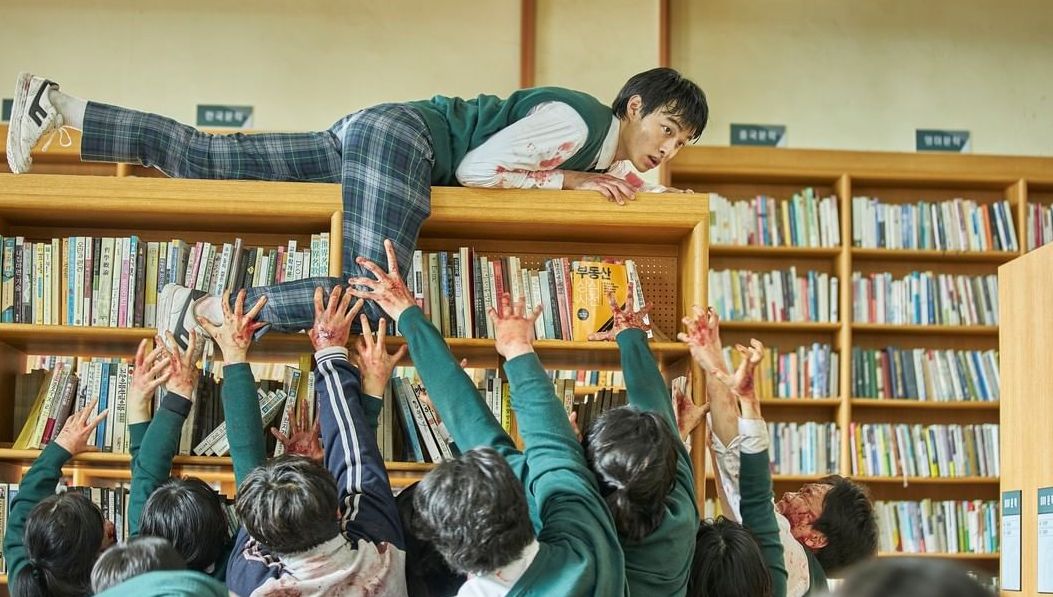
The story begins when a failed science experiment by a desperate biology teacher leads to the outbreak of a deadly virus that turns its victims into flesh-hungry zombies. What starts as an isolated incident rapidly spreads throughout the school, trapping students inside with no way to communicate or escape. Among the chaos, a small group of survivors — including Nam On-jo (Park Ji-hu), Lee Cheong-san (Yoon Chan-young), and Choi Nam-ra (Cho Yi-hyun) — band together to fight for their lives. Their journey from fear to resilience forms the emotional core of the series, blending horror with coming-of-age themes.
As the virus spreads beyond the school into the city, All of Us Are Dead expands its scope, showing how society collapses under panic and incompetence. The government’s response is chillingly pragmatic, treating infected zones as expendable, while the military’s attempts to contain the outbreak raise ethical questions about sacrifice and responsibility. This dual narrative — the students’ fight for survival and the adults’ moral compromises — mirrors the show’s larger message: in a crisis, monsters are not only the infected but also those who abandon their humanity.
Visually, the series is relentless. The camera work traps viewers in narrow corridors and blood-soaked classrooms, amplifying tension through kinetic, handheld shots that mimic the students’ chaos. Each zombie encounter is choreographed with horrifying realism, the infected moving with feral speed and convulsing rage. The sound design — echoing screams, the crack of bones, the thud of running feet — keeps the atmosphere suffocating. Yet, amid the carnage, the cinematography occasionally softens, capturing moments of tenderness, friendship, and fleeting hope.

One of the show’s most powerful elements is its emotional honesty. Every loss feels deeply personal; characters die not just as victims but as symbols of innocence lost. The evolving dynamic between On-jo and Cheong-san becomes the beating heart of the story — their quiet acts of care amid horror reminding us that compassion is the final form of resistance. Nam-ra’s arc, from isolated class president to tragic half-zombie heroine, embodies the struggle between control and chaos, human and monster.
The writing doesn’t shy away from social commentary either. All of Us Are Dead critiques bullying, parental neglect, and class disparity, using the zombie virus as a metaphor for the infection of societal cruelty. The high school becomes a microcosm of Korean society, where power, privilege, and indifference decide who lives and who dies. Each episode peels back another layer of human nature, showing that survival often comes at the cost of innocence and morality.
By the time the season concludes, All of Us Are Dead leaves viewers emotionally exhausted yet deeply moved. It’s more than just a zombie thriller — it’s a meditation on youth, fear, and the fragility of humanity. The final scenes, tinged with melancholy, suggest that survival is not an ending but a burden. With its gripping performances, sharp direction, and thematic depth, All of Us Are Dead stands as one of the most powerful entries in modern horror, proving that the scariest thing in an apocalypse isn’t the undead — it’s what we become to stay alive.


